Cognitive Behavioral Therapy (CBT)
Cognitive Behavioral Therapy (CBT) is the most extensively researched psychotherapy for addiction and mental health, proven in hundreds of clinical trials to reduce substance use, build coping skills, and protect long-term recovery. The Archangel Centers uses CBT as a cornerstone of outpatient treatment in New Jersey and North Carolina because its skills outlast the program.
Medically reviewed by Dr. Justin Skolnick, DO, Medical Director. Last reviewed June 7, 2026.
What is Cognitive Behavioral Therapy?
Cognitive Behavioral Therapy is a structured, goal-oriented form of psychotherapy founded on one core insight: thoughts, feelings, and behaviors are interdependent, and changing how a person thinks changes how they feel and act. Psychiatrist Aaron Beck developed the framework at the University of Pennsylvania in the 1960s after noticing that his patients held distorted, automatic beliefs that fueled depression. Subsequent decades of research expanded CBT into one of the broadest evidence bases in mental health, now covering addiction, anxiety, PTSD, eating disorders, chronic pain, and more.
In substance use treatment, CBT targets the cognitive and behavioral mechanisms that keep addiction going. A craving, a relapse, or a self-destructive choice rarely happens in isolation. CBT teaches clients to pause between stimulus and response, examine the automatic thought driving the impulse, and choose a different action. That pause is where recovery lives.
The National Institute on Drug Abuse identifies CBT as a first-line behavioral treatment for substance use disorders. The American Psychological Association's Division 12 lists it as an empirically supported treatment for depression, anxiety, and PTSD. SAMHSA's National Registry of Evidence-Based Programs includes multiple CBT-derived protocols. Few therapies have been evaluated as rigorously across as many populations, which is why CBT anchors so much of what happens in outpatient addiction care.
How CBT works for addiction: the ABC model
Substance use disorders are reinforced by predictable cycles of thought and behavior. CBT maps this cycle using what clinicians call a functional analysis: a specific trigger (a stressful call from family, a familiar neighborhood, a physical ache) activates an automatic thought (I cannot handle this sober), which drives a feeling (anxiety, hopelessness), which drives the behavior (use). Breaking the cycle requires intervening at the thought stage, where clients have the most leverage.
The ABC model at the center of CBT describes this clearly. A is the Activating event, B is the Belief or thought that follows, and C is the Consequence in behavior and emotion. The therapist and client work together to map real episodes from the client's own life, identify the exact belief that connected A to C, test that belief against evidence, and replace it with a more accurate and helpful one. Over weeks and months this process becomes automatic: the pause gets shorter, the healthy response gets faster.
Behavioral Activation is a second CBT mechanism especially important in addiction recovery. Substance use often fills the role of the only rewarding activity in a person's life. CBT addresses this by systematically rebuilding pleasurable, meaningful activities that compete with the pull of substances, giving the brain natural dopamine pathways that were crowded out during active use.
- Functional analysis: mapping every link in the trigger-thought-feeling-behavior chain
- Cognitive restructuring: identifying and challenging distorted automatic thoughts
- Behavioral activation: rebuilding rewarding sober activities and routines
- Urge surfing: observing a craving as a wave that rises and falls without acting on it
- Refusal skills: rehearsing how to decline offers or exit high-risk situations
- Problem-solving training: breaking overwhelming situations into manageable steps
- Sleep and mood management: addressing the lifestyle patterns that raise relapse risk
What a CBT session looks like
CBT sessions are structured differently from open-ended talk therapy. Each session opens with a brief mood check, a review of homework from the previous session, and a collaboratively set agenda for the hour. This structure keeps the work focused on the present problem rather than drifting through past history without a clear goal.
The clinical core of the session typically centers on a thought record: a real situation from the previous week, the automatic thoughts it produced, the emotions those thoughts created, and a more balanced alternative belief the client and therapist construct together. After the thought record, the therapist and client rehearse the new coping response through role-play or behavioral experiment, then assign homework to practice the skill before the next session.
Sessions typically run 12 to 20 weeks in research trial protocols, though outpatient addiction treatment schedules this work across PHP, IOP, and OP levels of care. Skills are introduced at higher intensity early and reinforced as clients step down, so the learning compounds rather than restarting.
- Agenda-setting at the start of every session so time is not wasted
- Homework review connecting last session's skills to real-world use
- Thought record on a specific, current situation
- Behavioral rehearsal or role-play of the new coping response
- New homework assigned with a clear, short task
CBT variants used in addiction treatment
Standard CBT has produced several evidence-based adaptations that are frequently woven into outpatient addiction care. Cognitive Behavioral Coping Skills Therapy (CBCST), developed specifically for alcohol and drug use at NIDA, organizes sessions around discrete coping skills and has strong trial support for reducing use and preventing relapse. The Relapse Prevention model by Marlatt and Gordon extended CBT into a framework for identifying high-risk situations, building coping plans, and recovering from lapses without catastrophizing.
Mindfulness-Based Cognitive Therapy (MBCT) merges CBT with mindfulness practice to reduce the rumination and automatic reactivity that precede relapse. Acceptance and Commitment Therapy (ACT), while technically a separate framework, shares CBT's cognitive heritage and adds a values-based direction to behavior change. CBT for insomnia (CBT-I) is increasingly integrated in addiction treatment because poor sleep is one of the most robust predictors of relapse, particularly for alcohol use disorder.
At The Archangel Centers, clinicians draw on these variants to match the approach to each client's profile. A client with heavy cognitive rumination may benefit from MBCT elements; a client with chronic insomnia will receive CBT-I strategies alongside core CBT work.
CBT for co-occurring mental health conditions
CBT is one of the few therapies with strong evidence for both substance use disorders and the mental health conditions that most commonly accompany them. This matters because the majority of people who seek addiction treatment carry at least one co-occurring diagnosis. Treating addiction without addressing the underlying mental health condition leaves the emotional driver of use intact, which is one reason relapse rates are higher in programs that do not address both.
CBT treats depression by targeting the negative, all-or-nothing thinking patterns that maintain low mood and fuel self-medication. It treats anxiety disorders by breaking the avoidance loops that keep anxiety alive and by building the tolerance for uncertainty that is central to staying in recovery. For PTSD, CBT provides structured trauma-focused protocols that reduce intrusive symptoms without requiring medication. For obsessive-compulsive disorder, Exposure and Response Prevention (a CBT variant) is the most effective treatment available.
- Alcohol use disorder and opioid use disorder
- Major depressive disorder and persistent depressive disorder
- Generalized anxiety disorder and panic disorder
- Post-traumatic stress disorder
- Obsessive-compulsive disorder
- Eating disorders (CBT-E is first-line treatment)
- Insomnia and sleep disturbance (CBT-I)
- Co-occurring substance use and mood disorders treated under one framework
CBT combined with Medication-Assisted Treatment
For opioid use disorder, the combination of buprenorphine or naltrexone with CBT-based counseling is among the most evidence-supported treatment approaches in addiction medicine. Medication stabilizes brain chemistry and quiets cravings so that therapy can do its work. CBT in turn builds the coping architecture that supports long-term recovery after medication is eventually tapered or maintained at a lower level. Neither piece works as well without the other.
The same logic applies to alcohol use disorder, where medications like naltrexone and acamprosate are most effective in combination with behavioral therapy. SAMHSA and ASAM both describe the integration of pharmacotherapy and behavioral treatment as the standard of care for these conditions. At The Archangel Centers, when a client is appropriate for Medication-Assisted Treatment, the prescribing and behavioral work are coordinated under one clinical team so the two reinforce each other rather than operating in parallel silos.
CBT in virtual and telehealth formats
A significant body of research now shows that CBT delivered via secure video is equivalent in outcomes to in-person delivery for most presentations. This matters for clients in New Jersey and North Carolina who face transportation barriers, work schedules that conflict with clinic hours, or who are stepping down to a level of care where in-person attendance is less practical.
Structured homework exercises, thought records, and behavioral rehearsal all transfer well to telehealth sessions. The Archangel Centers offers telehealth options within its outpatient program to ensure continuity of CBT work is not interrupted by scheduling constraints.
How The Archangel Centers delivers CBT across PHP, IOP, and OP
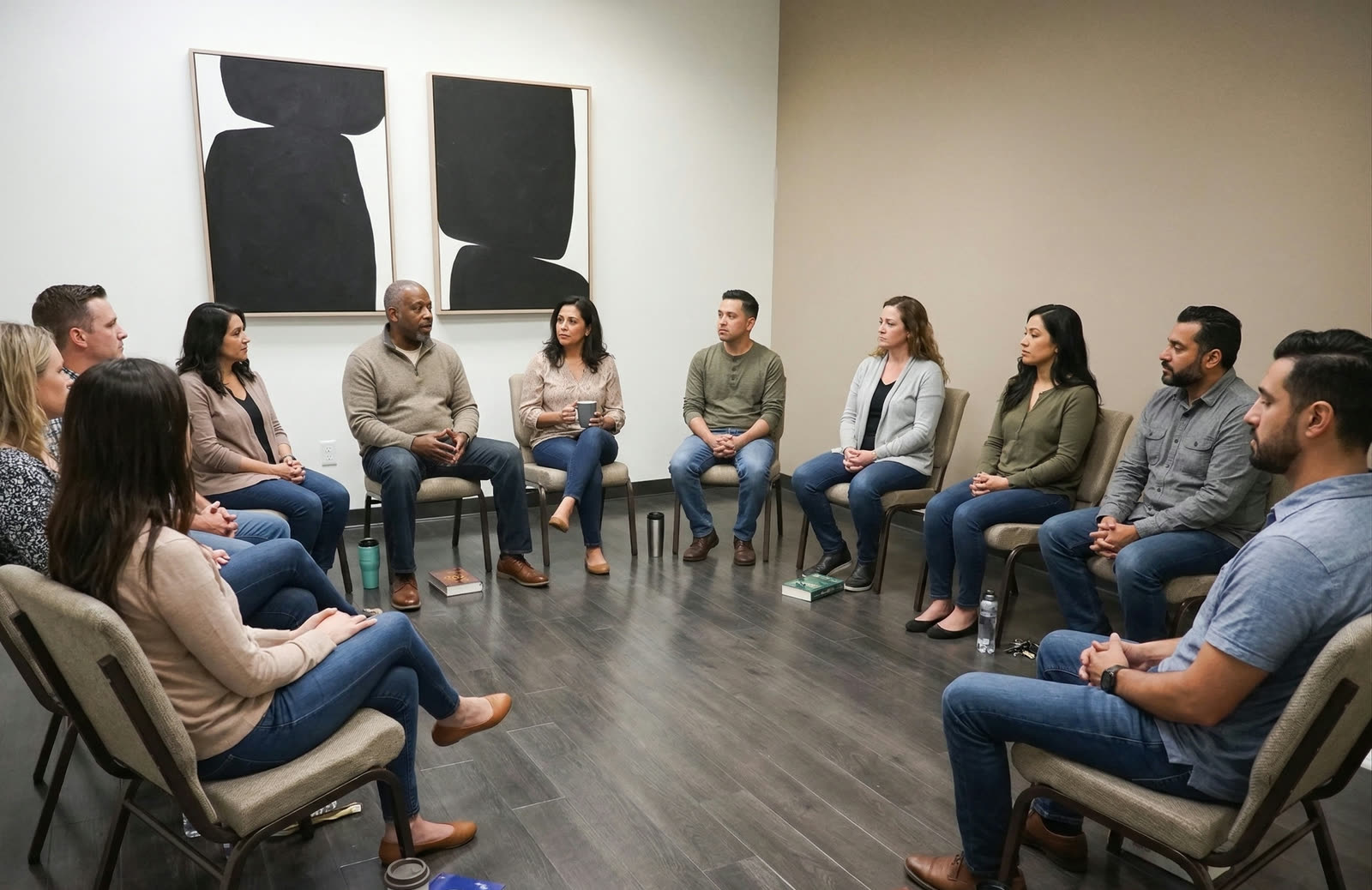
CBT is delivered in both individual sessions and group settings across all levels of outpatient care. In partial hospitalization, clients encounter CBT skills at high frequency, building awareness of their thought patterns quickly. In intensive outpatient, the same skills are practiced against the real-world challenges of returning to work, family, and community. In standard outpatient, sessions reinforce the most durable skills and address new triggers as they emerge.
Because the same clinical team works with clients across levels of care, the CBT work begun in PHP is never reset. The therapist already knows the client's functional analysis, their core cognitive distortions, and the skills that have taken hold. Progress compounds rather than restarts, and the skills a client has built are treated as assets to deepen, not a curriculum to repeat.
Common questions
How long does CBT take to work for addiction?
Many clients notice a measurable shift in how they respond to triggers within the first few weeks, because CBT teaches concrete skills that can be applied immediately. Research trial protocols typically run 12 to 20 sessions. Within an outpatient program, CBT is woven through PHP, IOP, and OP over several months, and the skills are designed to last a lifetime rather than taper off when treatment ends.
Is CBT just thinking your way out of addiction?
No. CBT does not ask clients to simply think positively or willpower their way to sobriety. It teaches a specific skill set: how to identify automatic thoughts, test them against evidence, and replace them with more accurate beliefs. That cognitive work is paired with behavioral skills like urge surfing, refusal practice, and Behavioral Activation that directly change what a person does in high-risk moments.
Does CBT work alongside Medication-Assisted Treatment?
Yes, and for opioid use disorder the combination is among the most evidence-supported approaches in addiction medicine. Medication stabilizes brain chemistry and quiets cravings; CBT builds the coping skills that sustain recovery. SAMHSA and ASAM both identify combined pharmacotherapy and behavioral therapy as standard of care for opioid and alcohol use disorders.
Is CBT different from regular talk therapy?
Significantly different. Traditional open-ended therapy is exploratory and often past-focused. CBT is structured and present-focused, with a session agenda, specific skills, and homework between sessions. Clients work on a defined problem rather than free-associating, and progress is tracked against measurable goals. Many clients find the structure more actionable, especially early in recovery.
Can CBT treat both addiction and depression at the same time?
Yes. CBT has strong evidence for both substance use disorders and mood disorders, which makes it especially valuable in dual diagnosis treatment. One consistent cognitive framework addresses the distorted thinking that drives both the substance use and the depression, keeping care coordinated and avoiding contradictory approaches from different providers.
Is the between-session homework really necessary?
The between-session practice is where most of the change happens. CBT teaches skills that only stick when used in real situations, such as a stressful day at work or a craving at home. Assignments are short and practical, such as a thought record or a behavioral experiment, and your therapist reviews them at the start of the next session. Clients who do the homework consistently get faster and more durable results.
Is CBT available at both the New Jersey and North Carolina locations?
Yes. Cognitive Behavioral Therapy is a core component of outpatient programming at both our Tinton Falls, New Jersey location and our Charlotte, North Carolina location, delivered by licensed clinicians across PHP, IOP, and OP levels of care. Telehealth options are available within the program for clients who cannot attend every session in person.
What if CBT does not seem to be working for me?
CBT is not the right fit for every client or every presentation. If structured skill work is not connecting, your clinician can incorporate EMDR for unresolved trauma, DBT for emotional dysregulation, or Motivational Interviewing to rebuild engagement. The goal is your recovery, not adherence to any single model. Your treatment plan is reviewed regularly and adjusted based on what is and is not moving.
Dialectical Behavior Therapy (DBT)
Skills for emotion regulation and distress tolerance.
Learn moreGroup Therapy
Healing in a supported peer setting.
Learn moreFamily Therapy
Repairing relationships and building a recovery support system.
Learn moreMedication-Assisted Treatment (MAT)
Medication paired with therapy for opioid and alcohol use.
Learn moreGet Outpatient Treatment, New Jersey
Founder-led outpatient care in Tinton Falls, New Jersey.
Learn moreGet Outpatient Treatment, North Carolina
Outpatient care for the greater Charlotte, North Carolina area.
Learn moreIn-network with most major commercial insurance plans
Verification is free and confidential, with no obligation. We tell you exactly what is covered for outpatient care before you commit.
I had the honor of touring this facility, and it was absolutely beautiful, clean, and thoughtfully designed. But more than how it looked, you could feel the love in every detail. Watching the staff interact with clients genuinely touched my heart.
John PereiraVerified Google reviewArch Angels gave me my life back. Their team is the most amazing, caring people I have ever met. The groups are amazing and this whole program is amazing. If you are tired of being sick and tired, reach out and save your life.
Cisco AvilaVerified Google reviewThis facility is run by some of the best people you could ever ask for. They are extremely professional and truly dedicated to helping those struggling with mental health and addiction. They truly saved my life.
Priscilla SeamanikVerified Google review