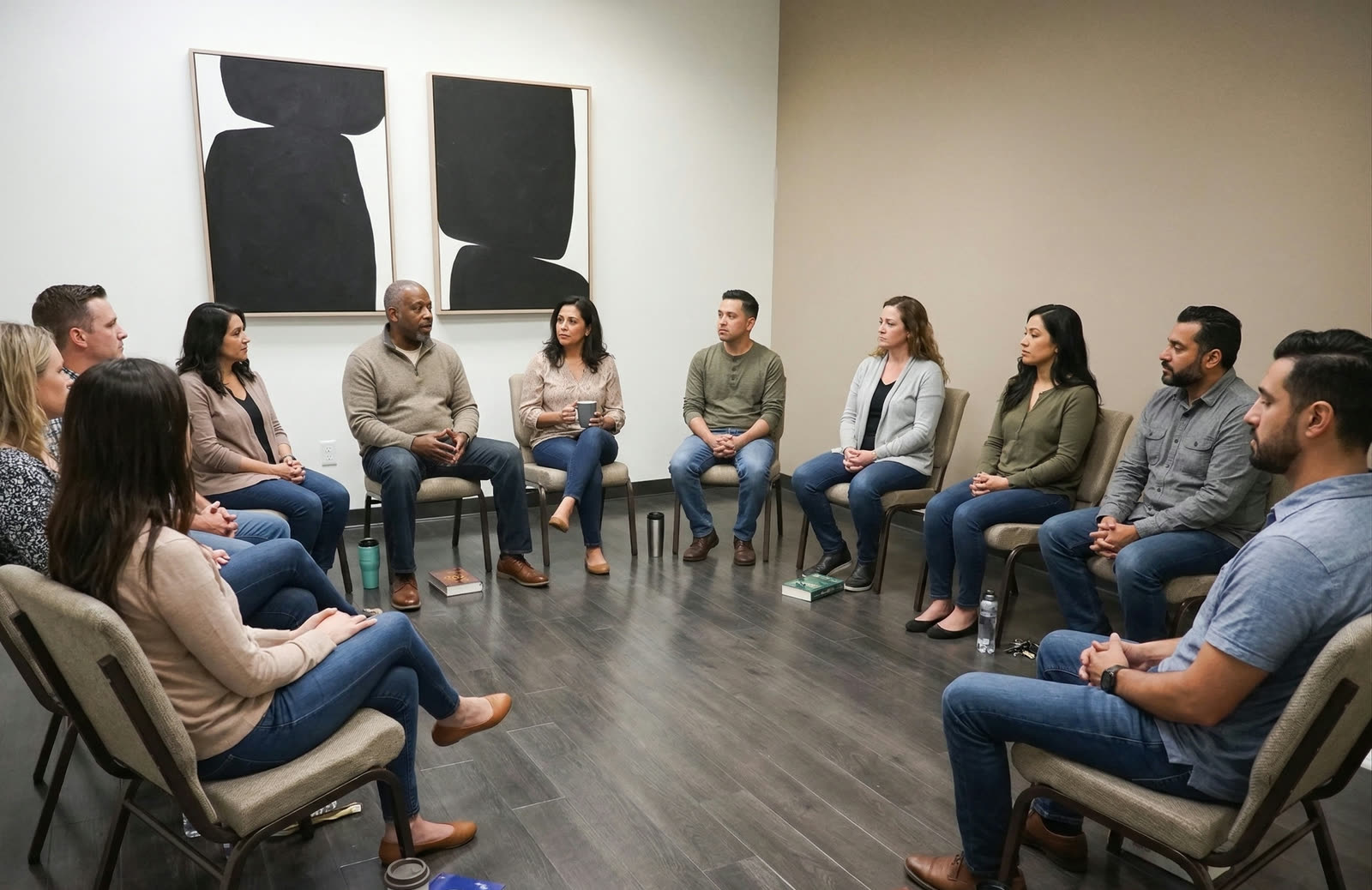
Group Therapy
Group therapy is one of the most effective and most underestimated formats in addiction treatment. It replaces the isolation and secrecy that addiction depends on with connection, accountability, and the lived proof that recovery is possible. The Archangel Centers makes it the structural backbone of outpatient treatment in both New Jersey and North Carolina.
Medically reviewed by Dr. Justin Skolnick, DO, Medical Director. Last reviewed June 7, 2026.
What is group therapy in addiction treatment?
Group therapy is structured clinical counseling led by a licensed therapist in which several clients work on recovery together. It is categorically different from peer support meetings like Alcoholics Anonymous or SMART Recovery. Group therapy is formal treatment: the clinician brings evidence-based frameworks, sets therapeutic goals, monitors the group dynamics, and adjusts the work based on what each client needs. The peer element is therapeutic, not incidental.
In the addiction treatment literature, group therapy is described as therapeutic for the same reasons that addiction is destructive: relationships. Addiction shrinks a person's world down to the substance and the behaviors that protect access to it. Group therapy expands the world again, creating a microcosm in which clients practice being honest, being known, and being accountable to other people who care what happens to them.
Research supports group therapy as effective as individual therapy for many outcomes in substance use treatment, and in some cases it outperforms individual work because it provides social learning, peer modeling, and interpersonal skill practice that individual sessions cannot replicate.
The therapeutic factors that make group work
Psychiatrist Irvin Yalom identified eleven therapeutic factors specific to group settings that account for much of the clinical effect. In addiction treatment, several of these are particularly powerful. Universality breaks the client's belief that their situation is uniquely shameful: seeing others carry the same struggles removes the isolation that secrecy feeds. Imitative behavior allows clients to learn by watching peers handle challenges they have not yet faced. Group cohesion, the trust and belonging that develop over time in a stable group, predicts treatment retention better than most individual factors.
Instillation of hope is one of the earliest-acting factors. When a client who is two weeks sober sits next to a client who is six months sober, the living evidence changes something. The belief that recovery is actually possible, not just theoretically achievable, begins to shift. Hope is itself a clinical variable in addiction treatment, and group delivers it in a form that lectures and individual sessions cannot replicate.
Altruism, the experience of genuinely helping another person in the group, is a recovery variable that is easy to undervalue. Many people in addiction have felt like a burden for years. The experience of mattering to someone else, of contributing something useful to another person's recovery, rebuilds the self-worth that addiction eroded.
- Universality: discovering you are not alone in your experience, which dismantles shame
- Imitative behavior: learning from how peers handle the same challenges
- Interpersonal learning: practicing honest communication in a low-stakes environment
- Instillation of hope: witnessing others achieve what you are working toward
- Group cohesion: the trust and belonging that make honest participation feel safe
- Altruism: experiencing the value of contributing to someone else's recovery
Types of groups offered at The Archangel Centers
A treatment week includes several different types of groups, each designed for a distinct clinical purpose. The clinical team mixes formats so clients receive education, skill practice, emotional processing, and peer connection throughout the program rather than all of one kind.
Process groups are the most relational format. The therapist facilitates open discussion of real experiences in recovery: triggers encountered since the last session, conflicts in relationships, fears about what comes after treatment ends. The group provides perspective, challenge, and support in real time. Process groups build the honesty and vulnerability that are foundational to sustained recovery.
Psychoeducation groups provide structured information about addiction as a brain disease, the neuroscience of cravings, the role of trauma, the effects of specific substances, and the mechanics of ASAM levels of care. Knowledge reduces shame and replaces the myths that clients often carry about what their addiction means about them as people.
Skills-training groups teach specific, evidence-based tools: CBT thought records, DBT distress tolerance techniques, relapse-prevention planning, communication skills, and mindfulness practices. These groups are more didactic and structured than process groups, with clear techniques to practice between sessions.
- Process groups: open, facilitated discussion of real recovery experiences
- Psychoeducational groups: structured information on addiction, the brain, and treatment
- CBT and DBT skills groups: teaching and practicing specific coping tools
- Relapse-prevention groups: identifying triggers and building personalized coping plans
- Dual diagnosis groups: addressing the interaction between addiction and co-occurring mental health conditions
- Trauma-informed processing groups: exploring how trauma underlies substance use
- 12-step facilitation groups: structured engagement with mutual-aid recovery frameworks
- Family groups: education and communication sessions that include loved ones
What to expect in your first group session
First-group anxiety is nearly universal, and clinicians account for it in how new members are oriented. The session typically opens with introductions in which each member shares their first name and where they are in the program. Ground rules are reviewed: confidentiality, one person speaks at a time, no advice unless asked. The group leader sets the tone explicitly so new members do not have to guess what the norms are.
The check-in round follows, in which each person takes a minute to describe how they are coming in: a number on a mood scale, a word, a brief update. This round is not an invitation to overshare or perform. It creates the opening for the session and gives the clinician a read on where each member is that day. After check-in, the group leader focuses the session on the theme or skill for that meeting, and the closing round brings everyone back to a stable state before leaving.
You are not required to share anything beyond your name on the first day. Many clients find the first several sessions most valuable as witnesses rather than participants. The invitation to contribute more opens as trust develops, and the clinician will never force disclosure.
Group size, structure, and confidentiality
Groups at The Archangel Centers are kept small enough that every member can be heard, typically six to twelve participants. Research supports this range as optimal: large enough to provide diverse perspectives and reduce any one person's self-consciousness, small enough that the clinician can track each member's engagement and that genuine connection develops rather than anonymity.
Group membership is as consistent as the program structure allows. In PHP, where clients attend daily, groups develop strong cohesion quickly. In IOP and OP, where attendance is less frequent, groups are scheduled to maintain regular contact between the same members. Consistency is a clinical ingredient, not a logistical convenience, because therapeutic factors like cohesion, modeling, and interpersonal learning depend on people actually knowing each other.
Confidentiality in group therapy is protected by both federal regulation and clinical ethics. Information shared in group sessions falls under 42 CFR Part 2, which provides stronger privacy protection for substance use disorder treatment records than standard HIPAA. Group members agree at intake to keep what is shared within the room, and the clinician reinforces these agreements at the start of each session.
What group therapy is not
Group therapy is not a substitute for individual therapy. Every client at The Archangel Centers receives individual sessions alongside group work. The individual relationship provides a space for material too sensitive for the group setting and allows for deeper, personalized clinical work that the group format cannot provide.
Group therapy in a clinical setting is not a 12-step meeting, though the two can and often do coexist in a recovery plan. 12-step meetings are peer-led, community-based, and organized around a shared recovery tradition. Clinical group therapy is a structured treatment intervention led by a licensed clinician with specific therapeutic goals and documented progress. Many clients use both: group therapy during treatment for clinical skill building, and community peer meetings as ongoing support after treatment ends.
Group is also not appropriate for clients in acute psychiatric crisis, active psychosis, or a state of agitation that would disrupt the safety and focus of other members. The clinical team assesses fit continuously and may temporarily redirect a client to individual work when group participation is not clinically indicated.
Group therapy at each level of care: PHP, IOP, and OP
Group therapy anchors the most clinical hours in outpatient treatment, and the schedule is calibrated to the level of care. In partial hospitalization, clients attend multiple groups per day, covering different formats across the week. The density of group contact in PHP creates rapid skill acquisition and early cohesion. In intensive outpatient, the group schedule is reduced but remains the primary treatment modality, with clients typically attending nine or more hours of group work per week across three to five days. In standard outpatient, group sessions continue at lower frequency as clients take on more daily responsibility outside the program.
Because the same clinical team works with clients across levels of care at both our Tinton Falls, New Jersey and Charlotte, North Carolina locations, the relationships and trust built in group carry forward through step-downs. Clients are not asked to restart with strangers each time their schedule changes. The peers and clinician who know a client's story in PHP are the same people who hold them accountable in IOP and celebrate their progress in OP.
Common questions
Will I have to share personal information in group?
You control what you share and when. Clients are encouraged to participate, but the clinician never forces disclosure and sets a respectful pace. Many people find that listening carefully in early sessions is valuable on its own, and the impulse to contribute grows naturally as trust develops. No one is put on the spot.
Is group therapy confidential?
Yes. Group sessions fall under 42 CFR Part 2, which provides strong federal privacy protection for substance use disorder treatment records. Group members agree at intake to maintain confidentiality about what is shared in the room, and the clinician reinforces this agreement at the start of every session. This shared commitment is what makes honest group work possible.
How is group therapy different from a 12-step meeting?
A 12-step meeting is peer-led, community-based, and organized around a shared recovery tradition. Group therapy is clinical treatment led by a licensed therapist with specific goals, documented progress, and evidence-based structure. The two serve different functions and work well together. Many clients use both: group therapy for clinical skill building during treatment, and community peer meetings for ongoing support afterward.
How large are the therapy groups?
Groups typically include six to twelve members with one licensed clinician facilitating. This range is supported in the research as optimal for balancing the diversity of perspectives that makes group work valuable with the intimacy needed for genuine trust and honest sharing. Groups are kept consistent in membership whenever possible.
Will I stay with the same group as I step down through levels of care?
The same clinical team works with clients across PHP, IOP, and OP, so the relationships and trust built in group are protected through step-downs. You are not asked to start over with strangers at each transition. The continuity of the group relationship is a clinical asset, not just a scheduling convenience.
Is group therapy available virtually?
Telehealth group options are available within the outpatient program for clients whose schedule or location makes in-person attendance difficult for certain sessions. Virtual group delivery has been shown to maintain therapeutic factors like universality, cohesion, and interpersonal learning when the group membership remains consistent across formats.
What if I am too anxious to participate in group?
First-group anxiety is nearly universal and the clinical team accounts for it. You are only asked to say your name and answer a simple check-in question on the first day. The invitation to contribute more opens gradually as comfort builds. If social anxiety is a clinical concern, it will also be addressed in individual therapy and may be a focus of skills work in group itself.
Cognitive Behavioral Therapy (CBT)
Changing the thought patterns that drive use.
Learn moreDialectical Behavior Therapy (DBT)
Skills for emotion regulation and distress tolerance.
Learn moreFamily Therapy
Repairing relationships and building a recovery support system.
Learn moreMedication-Assisted Treatment (MAT)
Medication paired with therapy for opioid and alcohol use.
Learn moreGet Outpatient Treatment, New Jersey
Founder-led outpatient care in Tinton Falls, New Jersey.
Learn moreGet Outpatient Treatment, North Carolina
Outpatient care for the greater Charlotte, North Carolina area.
Learn moreIn-network with most major commercial insurance plans
Verification is free and confidential, with no obligation. We tell you exactly what is covered for outpatient care before you commit.
I had the honor of touring this facility, and it was absolutely beautiful, clean, and thoughtfully designed. But more than how it looked, you could feel the love in every detail. Watching the staff interact with clients genuinely touched my heart.
John PereiraVerified Google reviewArch Angels gave me my life back. Their team is the most amazing, caring people I have ever met. The groups are amazing and this whole program is amazing. If you are tired of being sick and tired, reach out and save your life.
Cisco AvilaVerified Google reviewThis facility is run by some of the best people you could ever ask for. They are extremely professional and truly dedicated to helping those struggling with mental health and addiction. They truly saved my life.
Priscilla SeamanikVerified Google review